

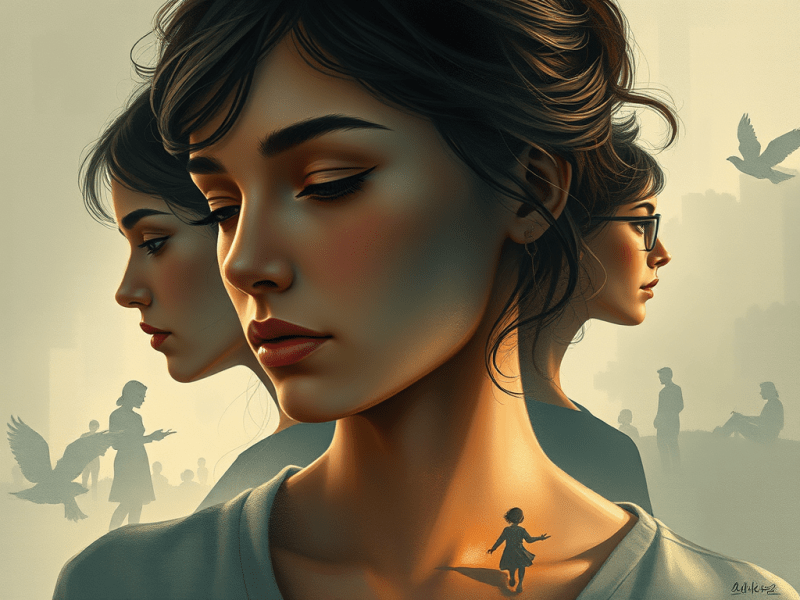
Finding My Voice at the Crossroads of Identity
For many years, I lived my life thinking I was alone in what I experienced and how I felt.
Wherever I looked, I didn’t see people like me. So, I tried to become someone I wasn’t—without ever truly understanding who I was.
The hurdles became harder to navigate over time, until everything imploded. I lost a pregnancy, became a single mum, discovered that both my child and I were neurodivergent, and then was demoted from my senior leadership role at work. All of this happened while I was still trying to wear a mask that helped me “fit in.”
I fell into a very dark place. And I knew that getting through it was up to me. For the first time in my life, I took a step back to really get to know myself—my identity, my values, and what I actually wanted from life.
That journey of self-discovery turned out to be more empowering and fascinating than I ever expected. And from that journey, I found a new sense of purpose in raising awareness and creating space for others.
When One Identity Isn’t the Whole Story
I began to understand something called intersectionality—the idea that different parts of our identity overlap and interact in ways that create unique challenges and barriers. Being a woman, a mother, and neurodivergent didn’t just add up—it multiplied the pressure I was under.
Yes, I felt it in leadership. As a middle-aged, neurodivergent woman and a mum in a senior role, I was constantly made to feel like I didn’t belong. The way I communicated, organised my thoughts, or showed up to lead was different—and different was often labelled as “wrong.” I was judged more harshly, constantly second-guessed, and made to walk on eggshells just to avoid triggering defensiveness in others.
But I’ve also felt the weight of intersectionality elsewhere:
- In the job market, where almost every opportunity seems built for someone with fewer responsibilities. Most job ads assume a default candidate: full-time, able to travel, flexible on location, available for core office days. As a mum with no support network, that already puts me at a disadvantage—before I’ve even submitted my application. But add my gender and my neurodivergence, and the gap widens even further — not just in how I’m perceived, but in how roles are structured, interviews are conducted, and success is defined.
- In relationships, where being a woman in a patriarchal culture is already challenging—but add neurodivergence to the mix, and it’s even more complex. My high empathy (common in many neurodivergent people) made me more vulnerable to emotional manipulation. I didn’t always recognise red flags. I now understand how gender expectations and neurodivergence combined to increase the risk of being targeted by narcissistic or abusive partners.
- In the legal system, where bias still runs deep. Women, immigrants, and people experiencing mental health issues are often disbelieved, dismissed, or treated with suspicion. And let’s be honest—if you’re accessing the legal system because you’ve been harmed, your mental health has very likely been affected. Yet that vulnerability is often used against you, instead of recognised as part of the harm done.
- In healthcare, where girls’ and women’s neurodivergence often goes undiagnosed because research is still largely based on male presentations. Where women are misdiagnosed with mental health conditions instead of correctly identified as neurodivergent — and where, later in life, perimenopause symptoms are dismissed, misdiagnosed as anxiety, depression, or even neurodivergence, and often unnecessarily medicated. Where women’s health is under-researched, and we’re left having to educate our GPs instead of being supported by them. And where the impact of perimenopause on neurodivergent women — or women with existing mental health conditions — remains poorly understood and deeply overlooked.
- In the workplace, where women don’t just struggle to access certain roles — they’re often sidelined as soon as they become mothers or begin navigating perimenopause. There’s little understanding of the mental load, or how shifting hormone levels affect brain function. Many women end up silently exiting the workforce long before retirement, unable to cope with rigid systems that offer no real support. And when you add neurodivergence and/or mental health into the mix, the barriers multiply: greater risk of exclusion, discrimination, bullying, and even fewer opportunities in spaces that are already difficult for women to enter. All of this, while having no role models to look up to — especially if you’re a neurodivergent woman.
Each of these examples shows how the barriers we face don’t exist in isolation. And when we’re forced to tackle each issue in a vacuum we’re left fragmented, unsupported, and unheard.
That’s why intersectionality matters. And why it needs to move from theory into practice.
We Were Never Alone
Once I started opening up, I realised just how many people were also navigating layered, often invisible challenges—many of them quietly.
I’ve heard stories of women fighting their way through exclusive work cultures, of neurodivergent people who were constantly misunderstood and excluded, and of people living with mental health challenges while trying to just “keep going.”
These conversations reminded me that the pain of feeling alone is real—but the truth is, we’re not alone. We just haven’t always had the space to find one another.
In fact, when I looked for support, I hit a wall. Just like probably many others that didn’t fit in one box only.
Women’s support groups didn’t address neurodivergence. Neurodiversity organisations didn’t address gender. I was kindly told to “go talk to someone else”—as if I could split myself in two. But I couldn’t. My challenges weren’t just about being a woman or being neurodivergent. They were about being a neurodivergent mum with no support network.
Neurotypical women didn’t face the same kind of pushback I did. And neurodivergent men didn’t either. I was carrying the weight of multiple layers of identity—and there was no space to go that truly understood the way they compounded.
So I decided to create it.
The Four Freedoms We All Deserve
Although Professor Laura Morgan Roberts originally shared this framework in the context of the workplace, I’d argue that these four freedoms apply to every aspect of our lives—not just our jobs.
Whether we’re at work, in our families, in social spaces, or in healthcare settings, we all deserve the freedom to be seen, to grow, to rest, and to make mistakes without fear of being judged more harshly because of who we are.
In her Harvard Business Review article, she outlines four essential freedoms people need to truly thrive:
🟠 The Freedom to Be
To show up as your full, authentic self and feel like you are enough.
This is often taken for granted by those in the dominant culture, while people in marginalised groups are left masking, suppressing, and conforming—at a serious cost to their health, confidence and sense of self.
🟡 The Freedom to Become
To grow, develop, and improve your life on your own terms.
But identity-based discrimination and systemic barriers make these opportunities harder to access for many.
🔵 The Freedom to Fade
To take a step back without being forgotten, overlooked, or penalised.
Marginalised people often face hypervisibility—where they’re always under scrutiny—and yet their contributions can still be undervalued.
🔴 The Freedom to Fail
This is the most critical of all.
Without it, the others fall apart. When we know we can make mistakes and recover, we gain the confidence to show up more fully. But members of dominant groups are often given more second chances, while those from marginalised backgrounds risk harsher consequences—especially when their mistakes play into harmful stereotypes.
If you’re a neurodivergent woman—or someone who carries other intersecting identities—you might be reading this and nodding along. Maybe you’ve felt the same. Maybe you’ve never had those freedoms either.
These freedoms aren’t a “nice to have.” They’re foundational to equity, dignity, and belonging. And yet, for many of us living at the intersection of multiple identities, they’re not a given—they have to be fought for.
Strength in Layers
For a long time, I was made to believe I had no strengths.
And I believed it—at least in part—because I worked so hard to be the person others expected me to be.
But when I finally began to find myself, I discovered something else, too:
My strengths had been there all along—rooted not in spite of my layered identities, but because of them.
Intersectionality isn’t just a burden. It’s not just about compounded discrimination or overlapping struggles.
It’s also a source of insight, power, creativity, and connection.
The interaction between my neurodivergence, gender, culture, lived experiences, and single parenthood has shaped strengths I now treasure:
- Resilience that helps me rise, again and again
- Empathy deep enough to truly understand others
- Intuition that lets me read people and rooms
- Creativity that builds entire worlds from ideas
- Perspective from moving through many cultures and roles
- Leadership rooted in strategy, awareness, and compassion
- Emotional intensity that allows me to love deeply
- Calm in chaos, even when everyone else is panicking in the room
- Curiosity and a constant flow of ideas
- A sense of purpose, even in pain
- A capacity for connection that goes beyond surface
- A hunger to learn—from others and from myself
These aren’t just traits I happen to have.
They are the product of my intersecting identities—and the gift of embracing them fully.
I know that without my intersectionality, I wouldn’t be able to reach my full potential.
That’s why I need to create space—for myself and others—where we don’t have to mask.
Because when we mask, we’re not hiding our flaws.
We’re hiding what makes us different.
And those differences are exactly what make us great.
The Support I Needed Didn’t Exist, So I Built It!
I created The Intersectional Hub because I needed a space where all parts of me could exist—without having to choose which version of myself was acceptable that day. A space that didn’t just “celebrate diversity” in theory, but understood how different layers of identity can create invisible challenges that most people don’t see.
I’m also excited to introduce the Intersecting Voices podcast, where I sit down with people from all walks of life to unpack how intersectionality shapes their lived experiences. Each episode opens up new perspectives—and this blog will serve as a space to go deeper into the topics we explore there.
Let’s Build This Together
This is just the beginning—and I’d love for you to be part of it.
💬 Share your thoughts in the comments—your story, your questions, or what resonated most with you.
🔁 If this post made you think of someone, send it their way.
📣 Help me spread the word by sharing this blog with your networks, your groups, your people.
Together, we can grow The Intersectional Hub into the inclusive, supportive space we all wish we had. One where every part of our identity is seen, understood, and valued.
And don’t forget: The Intersecting Voices podcast launches next week with Bobby Rubio, director of Pixar’s FLOAT, in which we talk about parenting neurodiverse children and cultural representation in the screens—so make sure to follow or subscribe wherever you get your podcasts from if you haven’t already. This is your space too, and I can’t wait to hear your voice in it.


 The Intersectional Hub
Leave a comment